Jan 182011
 

Great racquetball players have great footwork. They know where the racquetball is going and seem to glide into it in one or two steps. And, most importantly, top players time their steps so they arrive at the ball at the perfect moment.

So, without proper racquetball footwork, you cannot get into the correct setup position to hit the ball. You can have perfect swing techniques but still find it difficult to hit the ball due to awkward foot movement. Because the ball is moving and changing direction, your footwork requires you to track and move on a parallel path with the ball.

Beginners tend to run directly at the ball and end up getting too close to the ball. But much like in squash play, you need to learn how to approach the ball in a curved or banana shaped pathway. And you must pivot into the correct position facing a side wall when striking the ball.

The most common foot and leg movements in the back court are the split-step and the shuffle-step. The split step gets your feet ready and on your toes to begin movement in any direction. Use the shuffle-step to move towards the back wall.

Jan 172011
 

You are at a huge disadvantage when returning a serve.

  1. The server gets to hit the ball at you as hard as they can.
  2. The server gets to hit the serve directly at your weakness.
  3. You occupy the worst position in the court.
  4. If your opponent wins the rally, you will lose a point.

So a good return of service will allow you to get in front of  your opponent and force them to make a shot from the back of the court. Generally speaking, the most effective way to accomplish this is to return the serve with a ceiling ball.

It is vital to be in a ready position when returning the serve. Your racquet needs to be up in front of you at chest level and held with a backhand grip. Do a small split step when the server hits the ball so you are up in the air and can move in any direction.

Your entire goal in returning serve is to get to the center court position. Remember, if you are not in center court during a rally, then you are losing the rally.

TIP : To return serve, a good starting point is to be about an arms length from the back wall and in the center of the court.

TIP : Be ready to move forward to cut off lob serves early and return them to the ceiling. This gives the server less time to get to the back court and gets you immediately into center court position.

Jan 152011
 

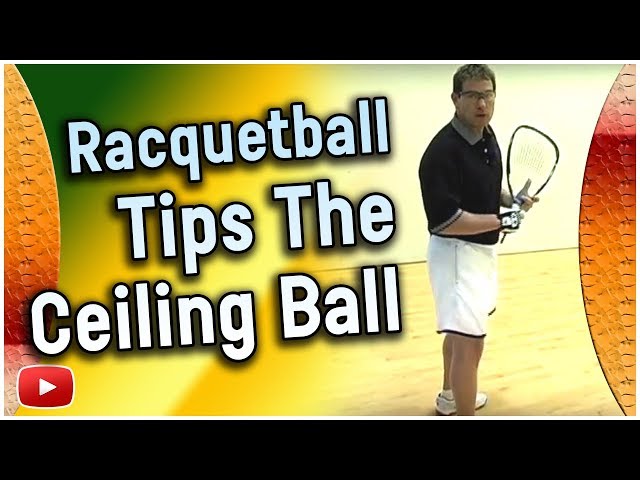
Use racquetball ceiling ball shots to move your opponent out of center court. The ceiling ball forces them into one of the back corners of the court and allows you time to take the vital center court position.

Ceiling shots are also one of the best returns of service. And a good ceiling ball player can wear their opponent out by pinning them in the back corners on every rally. Then as soon as they miss a ceiling ball return, you end the rally with a down the line or pinch shot.

It is very easy to practice ceiling balls on the court by yourself. Start off hitting 10 to 20 in a row.

Another great way to practice ceiling balls is by playing a ceiling ball game, allowing only lob serves and ceiling balls. If you miss the ceiling, you lose the rally.

These videos by Rocky Carson, Mary Hogan, John Ellis, and Shawn Royster go over the how/why for hitting ceiling ball shots.

Jan 152011
 

Serving is the most important part of scoring points in racquetball. So this is the area where you should practice the most. Your goal is to hit serves which are the most difficult for your opponent to return. So do not always hit your favorite serves all the time if they are not winning you points.

Many top players aim for exact targets on the front wall. Starting from the same position in the serving box, you should have a precise spot on the front wall to hit a drive serve to the back left corner, a Z-serve to the same corner, a wide angle jam serve, and a down-the-line drive serve. With practice, you gain confidence in your front wall targets. Then during a match, you do not need to rely on “feel” to hit confident and accurate serves.

TIP : Take a dry erasable marker and draw a 6-inch diameter target circles on the front wall for each of these 4 serves. Hit ten serves to each target, starting from the same position in the serving box. Do not try to change your starting position. Then hit ten serves picking a random target. Hitting to specific targets gives you instant feedback and will accelerate the learning process.

TIP : During one practice game, try alternating serves to both back corners of the court with either Z-serves or drive serves.

TIP : During one practice game, before hitting your serve, look and focus carefully on the wall target. This tells your brain exactly what you want it do. The more specific a task you give your brain the more likely that it will be successful.