The Racquetball Screen Serve FAQ
What exactly does the rule say?
Rule 3.9 (h) Fault Serves Screen Serve – “A served ball that first hits the front wall and on the rebound passes so closely to the server, or server’s partner in doubles, that it prevents the receiver from having a clear view of the ball. The receiver is obligated to take up good court position, near center court, to obtain that view.”
When Does a Screen Serve Occur?
Screen serves normally occur during fast serves, since slower serves allow the receiver a view and time to see where the ball is moving. With rare exceptions, screen serves may also occur after hitting a side wall.
Who Makes a Screen Serve Call?
Only the “receiver” (or referee) may call a screen serve. The receiver, or referee, may make a slow or no call if the serve becomes playable off the back wall. The receiver may not play a serve, then because of a poor return shot, ask for a “screen serve” call.
The Ball Must Be How Far Away From the Server?
There is no designated distance the ball must pass the server by, since it is difficult to measure while playing.
What Determines a Screen Serve?
The server is allowed to hide the ball from the receiver during contact to and from the front wall. But the ball must be in clear view to the receiver as the ball passes next to the server inside the service zone. Good serves are sometimes hit so fast that the receiver may not have time to react and argue for a screen call. Situations may be resolved by determining the path of the ball between the front and the back wall in relation to the server’s position.
How Does One Make a Screen Serve Call?
The receiver should “signal” by raising their non racquet hand above their head during the
serve return, but still attempt a return, if possible, unless they believe they may hit the opponent.The signal tells the server (referee) that you will be requesting a screen serve, or any other service rule call like a foot fault, short or long serve. Screen serves are faults.
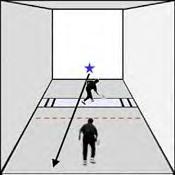
 Good Serve (Fig 1) Good Serve (Fig 1) |
This serve is from the center area and away from the server. It could be a screen serve if ball path was closer to the server and further from the side back wall corner. Figure 2 shows the same player positions with the serve passing too close to the server. |
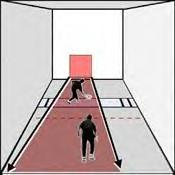
 Screen Serve (Fig 2) Screen Serve (Fig 2) |
This ball passes too close to the server. Only the receiver may call a screen serve. The receiver may play the serve, especially if the serve is playable after rebounding off of the back wall. The receiver is not allowed to play a serve, then wait to see if they hit a good shot before calling a Screen Serve. |
 Screen Serve (Fig 3) Screen Serve (Fig 3) |
Server is left of center court. The red shade shows possible screen serve area. Notice that the ball is hit from the center of the court while the server is positioned just left of center court. This explains the greater chance for a screen to occur at the left side. |
 Screen Serve (Fig 4) Screen Serve (Fig 4) |
The server is in center court. The serve is actually hit just right of center court. Red shade shows possible screen serves. The angle of the ball will likely pass closer to the server on the left side, since the ball was hit slightly right of center court. |
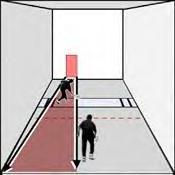 Screen Serve (Fig 5) Screen Serve (Fig 5) |
Server is at left side of court. Any serve to the left side that does not go directly to the left back corner will be a screen serve. Any serve hit to the right of the server’s body will not be a screen serve, but could result in a Penalty Hinder (side-out) if the server is blocking a straight-in or cross court return by the receiver. |
 Screen Serve (fig 6) Screen Serve (fig 6) |
Server is at right side of court. Any serve to the right side that does not go directly to the right back corner will be a screen serve. Because the serve is hit at the right side of the server’s body, the angle is slightly different from what occurs in Figure 4 above. This slight angle increase will occur when a right-handed server positions right of center and serves left. |
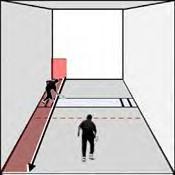 Screen Serve (Fig 7) Screen Serve (Fig 7) |
Server is at left side wall and must serve to the right side. Server is violating Drive Serve Zone and may not serve a drive serve down the left side wall. |
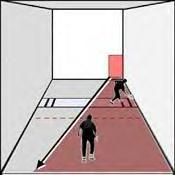 Screen Serve (Fig 8) Screen Serve (Fig 8) |
Server is at right side wall and must serve to the left side. Server is violating Drive Serve Zone and may not serve a drive serve down the right side wall. |
Special thanks to WEB Racquetball for the screen serve diagrams.