Apr 252011
 

bruiseball

Are you often getting hit by the ball in the back of your legs or in your back?

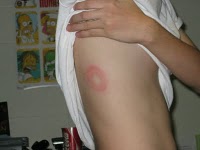
Do you often have large red circular raised welts in your skin which slowly turn into black bruises?

Are you are standing directly in front of your opponent while they are hitting the ball?

Do you look at the front wall while your opponent is shooting the ball?

If you answered yes to any of these questions, then you are playing bruiseball instead of racquetball.

And, you are breaking a fundamental rule of racquetball in which you must allow your opponent to hit directly to the front wall or cross court:

3.15 – Penalty Hinders

(a) Failure to Move. A player does not move sufficiently to allow an opponent a shot straight to the front wall as well a cross-court shot which is a shot directly to the front wall at an angle that would cause the ball to rebound directly to the rear corner farthest from the player hitting the ball. In addition, when a player moves in such a direction that it prevents an opponent from taking either of these shots.

Your opponent has the right to stop his swing and call a penalty hinder if you violate the Failure to Move rule. A penalty hinder results in the loss of the rally.

So how do you stop playing bruiseball?

  • Never take you eyes off the ball. And especially watch the ball when it is moving behind you. You should be able to watch your opponent hit the ball.
  • You cannot stand in center court if it interferes with your opponent in any way.

So get out of the way!  You are not allowed to take away your opponent’s offensive shot after you have hit a terrible shot that rebounds to the center court.  If you get hit standing in your opponent’s hitting lane, it is a penalty hinder and you should lose the point!

Note — the many benefits of watching the ball were discussed in this post.
Apr 142011
 

This tip from RacquetWorld Pats Tip of the Month discusses the importance of keeping your shots from rebounding off the back wall. The No Back Wall tactic is especially important when serving:

I often tell players simply “no back wall”. In short, this means that no ball you hit, drive serve, passing shot, ceiling ball, cross court or even the round-the-world ball, should rebound off the back wall, resulting in a setup shot for your opponent.

In addition, the “no back wall” tactic insures all passing shots (once past your opponent) are winners with no second chance of retrieval via a rebound off the back wall. Passing shots also have a far less chance of skipping compared to other shot choices.

So by adjusting your game towards passing shots, you are also drastically cutting down on your unforced errors. Plus, you put enormous pressure on your opponent when they realize that they must cut off each shot before it goes by them because there is no second chance. A hard hit passing shot is one of the hardest shots for an opponent to redirect accurately which also results in more easy setups for you.

The second bounce of a properly struck ceiling ball should land deep in the court at 39 feet (the back wall is at 40 feet). A ceiling ball which is moving away from the front wall is much more difficult for your opponent to return. Inversely, a ceiling ball that comes off the back wall  is easier to handle and allows your opponent to hit a passing shot at knee level.

A well struck ceiling ball should pin your opponent in a back corner with no shot off the back wall. If they attempt  to hit a passing shot or kill shot, it is much more likely that they will will skip the ball.

I saved the most important point for last. No back wall on any serve…EVER! Drive serves should be short or aces—bouncing twice before the back wall. Lob serves should never come off the back wall.

So keep the “no back wall” strategy in mind when you play your practice matches. Try to reduce the number of times your shots rebound off the back wall, and especially commit to the idea that drive serves should be short or aces.

More great tips and advice can be found at Pat’s Racquetball Tips.

Mar 292011
 

In his March 2011 monthly newsletter, Racquetball Tim discussed how to hit a harder forehand by using a compact and focused swing. According to Tim, here’s the order in which things happen for a normal drop and hit forehand:

1.  Drop the ball AWAY from your body so that you have full arm extension at ball impact.

2.  Take a small step directly toward the front wall with your left foot.  Your racquet should still be up at shoulder level as you take your step toward the front wall. Do not drop your arm and racquet as you take your step.

3.  Lead with your elbow. The racquet lags behind as your elbow leads.

4.  The upper body and arm follow the hip rotation. When you finish your swing, your chest should face the front wall. This will make sure that you’ve rotated your hips properly.

5.  To make sure that you completely rotate your hips through the zone, clear your non-racquet arm out-of-the-way. Pretend there is a bush right next to you, between you and the front wall. Use your non-racquet arm to “move” this bush out-of-the-way. Do not bring your non-racquet arm up to your chest during the swing. It gets in the way, preventing  proper hip rotation, and limiting the amount of generated power.

6.  As the hips rotate, pretend there is a bug under your back foot. You need to pivot on your back foot  to squish the bug.

7.  When you’ve completed the swing your belly button should face the front wall with your racquet pointing toward the back wall.

If you’ve done these things and you still aren’t hitting the ball as hard as you want, you’re probably making one of the following errors:

Check your grip
At the point of contact (directly in front of your front heal for a straight-in shot) your racquet should be parallel to the front wall. If it’s angled slightly you’ll probably end up slicing the ball or putting topspin on it like tennis players do.

Drop the ball AWAY from you
Most people are comfortable contacting the ball close to them. If you want to hit harder you need to learn how to swing flat and level, which means you need to hit that ball at full arm extension away from your body.

Mar 202011
 

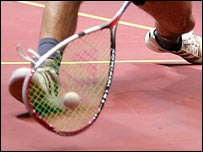
squash lungeFor two years I played competitive squash in France. I participated in the Isle de France League and also in local Paris tournaments. All squash players in leagues and tournaments in France are ranked based on their match results, so I started out at the bottom, ranked around No. 4500 in France.

I initially tried to use racquetball techniques on the squash court. I played very fast and tried to hit the ball low and just above the tin. Because of my poor court positioning, I was always in the way and exasperated by the stroke calls made against me. This aggressive style of play always totally wore me out. After struggling to learn how to play squash correctly, I finally got some coaching from Thierry Scianimanico, an amazing top 20 French squash player. It took me a year to stop trying to play racquetball in a squash court. I then quickly moved up in rankings to a respectable 3C level, or around No. 750 before moving back to the US.

By playing so much squash, I was in much better shape. As a side benefit, I had also immensely improved my racquetball game !

So what key things did I learn from playing squash:

  • Play your opponent, not the ball. In squash, your shot selection is always dependent on the court position of your opponent.
  • Keep your opponent behind you by hitting deep, wide angle passing shots.
  • Run your opponent diagonally from front corners to back corners.

Squash also requires a higher level of fitness than racquetball! In squash, you literally try to run your opponent until they are gasping for air.

FWIW,  even the world No 3 ranked racquetball pro, Jack Huczek, plays squash. In an interview, he describes his typical training regimen:

I’ll play racquetball 4-5 days a week. I’ll do strength
training 5 days a week. I’ll do speed training 3 days a week. I’ll do
squash for cross training purposes 2 days a week.

So if you want to improve you racquetball game and improve your fitness, try playing squash regularly. But be careful, because you just might get hooked on the game.